Planned like a local
After planning two trips abroad with AI chatbots, I turned the process into an Android app: answer a few questions and MeuPlan writes the whole itinerary, translates on the spot and tracks spending. I designed and built it in about three weeks with AI agents; it's now in closed beta on Google Play.
Two trips, two chatbots
Last year in South Korea, I planned each day on the spot: every morning I asked Gemini where to go, and we followed. It worked, but the answers were generic, and I kept reshaping them to fit our taste.
This year, before 2.5 weeks in Japan, I tried the opposite: a ChatGPT session that asked lots of questions about how we travel, then wrote a plan. It was surprisingly good, so I turned the process into an app.
I'd always wanted to design and build an app from the ground up, Android especially. This was the excuse, and the goal was to do it fast.
Is it a real problem?
While building, I interviewed two colleagues and two close friends. All four said the same thing: planning a trip abroad, especially the first time, is a hassle. You're not a local, so the hidden gems are hard to find.
“How might we give travellers a plan that feels like a local made it for them, and keep it useful when there's no signal?”
Three jobs, one app
MeuPlan covers the three jobs a trip asks of you, and onboarding gives each one a screen:
- Plan. Answer a few questions and it writes the whole itinerary, hour by hour, in an order that makes sense.
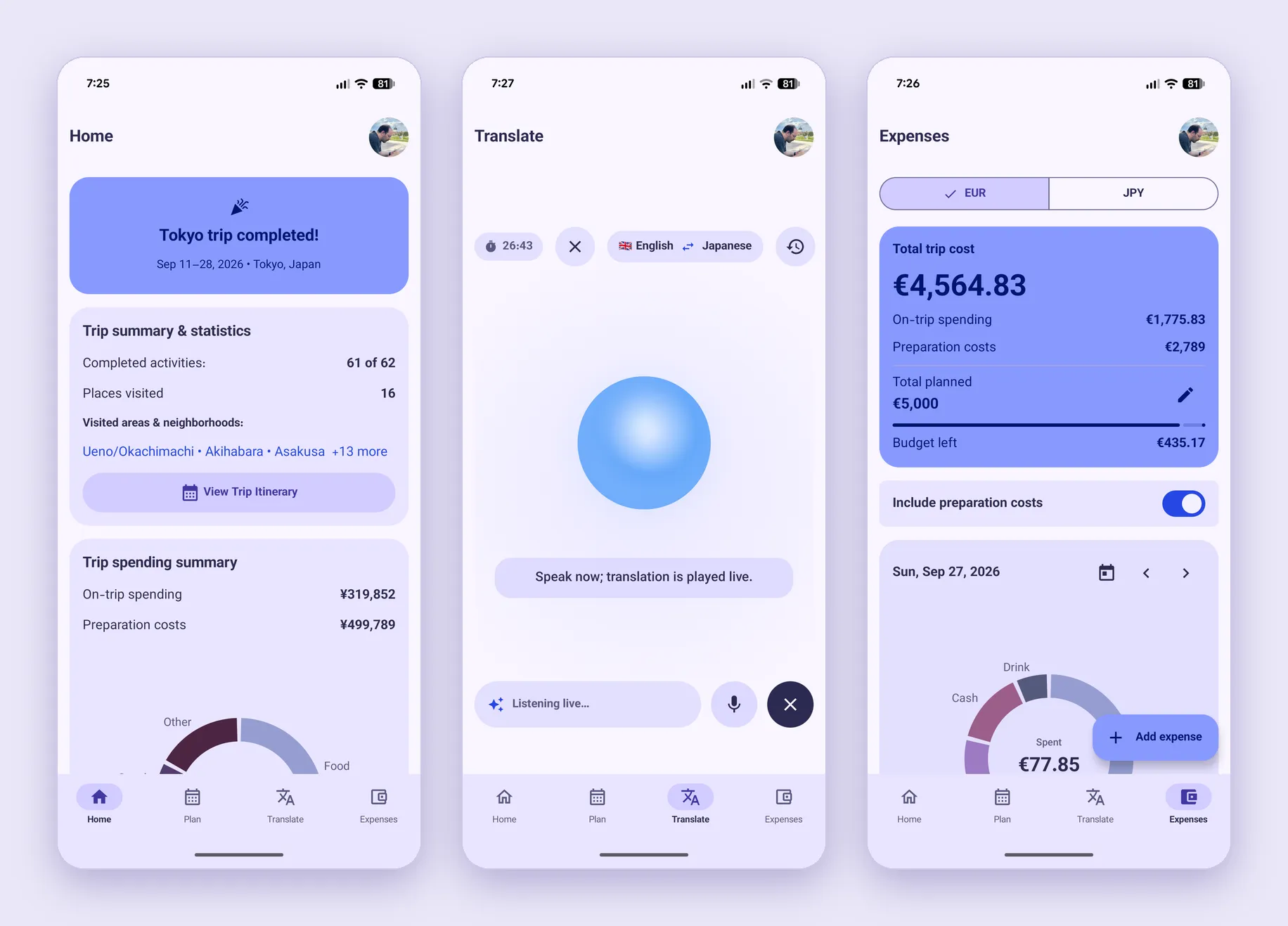
- Talk. Speak and hear it back in the local language, with phrasebooks and an emergency mode.
- Spend. Log costs in the local currency, read them in your own, against your budget.
What shaped it
Chatbots gave me generic lists until they knew about us.
I chose a short interview, then a whole itinerary over a feed of popular places.
WhyThe questions are what made the ChatGPT plan good. Answer them once and you get days built for you, in an order that works.
Abroad, signal is patchy and roaming is expensive, often right when you need the plan.
I chose an itinerary that works offline over an assistant you must be online to ask.
WhyA travel app that fails in a metro tunnel fails at its job.
Building alone in three weeks, there was no time for a custom design system.
I chose Material 3 Expressive, Android's own design language over a custom visual style.
WhyNative components, motion and dynamic colour came built in, so the time went into the experience. People can still pick one of twelve palettes, or follow their system.
Plan, talk, spend
Starting takes two steps: sign in, or skip for now, then pick your dates and a city. Appearance follows the system, or one of twelve palettes.
Talk. Live Translate listens and speaks back in the local language. For the moments that can't wait, common phrases come in the local script with pronunciation, and an emergency mode puts the urgent ones first.
Spend. Costs are logged in the local currency and shown in yours, split into preparation and on-trip, against the budget you set. When the trip ends, home shows the whole picture.
A team of agents
I designed and built MeuPlan myself, with AI agents as the team: Antigravity, Codex and Claude Code, each set up for one job, such as design, coding or architecture. I set the direction and made the product and design calls.
From idea to closed beta took about three weeks. That was the point: to see how fast one designer can ship a real product.
Tested on our own trip
We used MeuPlan for our trip to Tokyo, 11 to 28 September 2026. By the end we'd done 61 of 62 planned activities across 16 places, and stayed within budget.
Live in closed beta
MeuPlan is in closed beta on Google Play, and anyone can join: become a tester, then install it from Google Play.
What I learned
Agents speed up the build, not the judgement
AI wrote much of the code. Deciding what to build, and what to leave out, was still the job.
Design for the worst moment
No signal, no shared language, an emergency: the hardest moments shaped the most useful features.
Use the platform
Material 3 Expressive gave a polished, native app from day one, so the time went into the experience.
What I'd measure next
How much of each generated plan people keep, and where they change it.